Murderer released from jail became crime reporter – but he was hiding terrifying secret
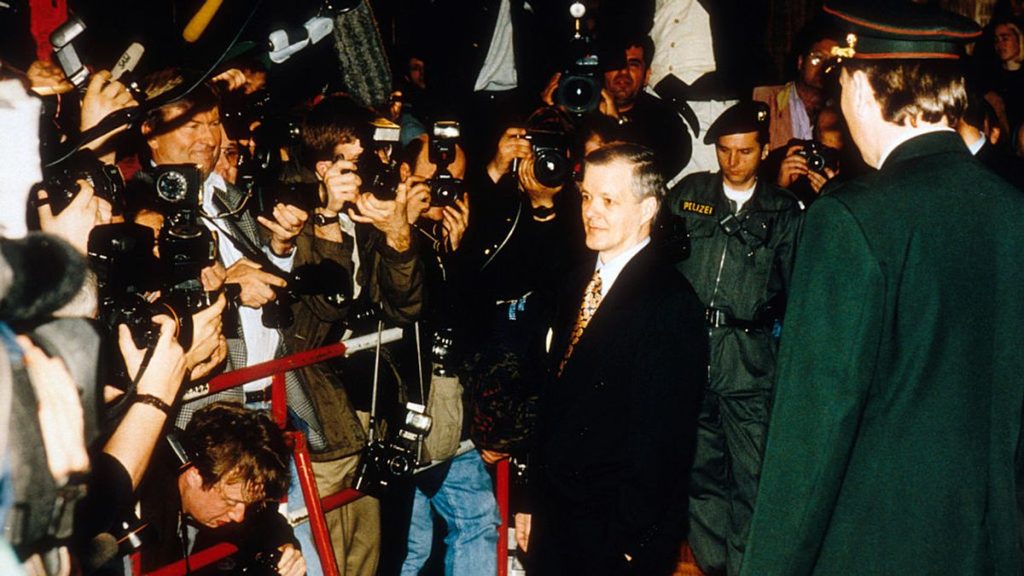
WARNING: DISTRESSING CONTENT: Politicians and intellectuals lobbied for the release of rapist and murderer Jack Unterweger – but as soon as he regained his freedom he began to kill again

Unterweger became a celebrity in his native Austria(Image: Sygma via Getty Images)
A murderer who was released from jail after he became a “poet” behind bars seemingly turned his life around – but all was not as it seemed.
Jack Unterweger’s first murder conviction had been in 1974, when after burgling a house in Ewersbach, Germany, he kidnapped an 18-year-old woman who had surprised him and his female accomplice in the act. He took the woman, Margret Schäfer, to nearby woodland where he clubbed her repeatedly over the head with an iron bar.
He then sexually assaulted his victim with the iron bar before strangling her to death. He tied Schäfer’s bra around her neck in what investigators described as a “hangman’s knot” before covering her body with dirt and leaves.
He continued his crime spree, picking up a second underage girlfriend as he travelled around Austria and Germany, acting as a pimp to the two young women and committing several other sick sexual assaults that bore a chilling similarity to the murder of Margret Schäfer.
After running short of money, Unterweger attempted to ransom one of his teenage girlfriends back to her parents, but was instead arrested and initially charged with kidnap before eventually being convicted on four counts of rape and sexual assault, as well as the murder for which he was sentenced to life in prison.
But it was while he was in prison that the killer’s manipulative nature became apparent. He treated his life sentence as an opportunity. He began writing poems and essays that gained national attention. He edited a literary magazine, wrote plays, and even published an autobiography that turned him into a minor celebrity.
Unterweger’s autobiography told how his mother, who he claimed had been a sex worker, had become pregnant after an encounter with an unnamed US serviceman. He claimed that his grandfather had forced him to watch as he had sex with a variety of strangers, as well as involving him in the theft of livestock from nearby farms.
The book also contained a lurid tale in which Unterweger claimed to have watched as his closest friend died after falling underneath a steamroller. Unterweger’s mother disputed many of his stories, saying that he had only invented her involvement in prostitution “to make his book sell better.”
Writers, artists, journalists and politicians took up Unterweger’s cause. They saw him as living proof that rehabilitation of even the worst criminals was possible. An Austrian writer went to Stein prison to hear Unterweger read from his work. “He was so tender,” Kolleritsch said, “and at that moment we decided we had to get him pardoned.”
In May 1990, at the earliest moment the law allowed, Unterweger was granted parole. He became a national celebrity and was hailed as “a triumph of the individual over all the social and political pathologies into which he’d been born.”
Unterweger gave readings to rapturous audiences across Austria and Germany, wrote plays, and worked as a reporter for Austria’s national broadcaster.
But everywhere Unterweger went, women died. In the first year after his release he is known to have killed at least nine women, and possibly as many as 11 — every one with her own underwear tied around her neck in the “hangman’s knot” he had used on Margret Schäfer sixteen years earlier.
Chillingly, Unterweger had established himself as a true-crime reporter and was even invited on national TV to comment on the rash of killings across Czechoslovakia and Australia.
Commissioned by an Austrian magazine to write about crime and prostitution in Los Angeles, Unterweger was invited on a ride-along in an LAPD patrol car as it toured the city’s red-light districts. While he was in Los Angeles, three sex workers were strangled to death in the city. Every one of them had been asphyxiated with Unterweger’s tell-tale “hangman’s knot.”
Even then, he escaped capture, although some within US law enforcement had their suspicions. An FBI agent who met Unterweger and later testified about him in court described him as a “presence … a malevolent thoroughbred.”
But eventually, the evidence against Unterweger became too much to ignore. Realising he was about to be arrested in Austria, he fled to Miami, Florida, where he was finally arrested by US Marshals in February 1992.
Extradited back to Austria, where most of his crimes had taken place, Unterweger still enjoyed the support of the media. He was known as “the Murder Poet” and reports on national broadcaster ORF frequently leaned on the childhood trauma he had described in his book and stressed that he was “only a killer of prostitutes.”
But on June 29, 1994, Unterweger was sentenced to life in prison without possibility of parole. That night, he used his trouser drawstring and a length of thin wire to make one last hangman’s knot. Because he had died before the court could hear an appeal, the guilty verdict against Unterweger was not considered legally binding under Austrian law.