Haunting final photo of woman fitted with ‘bomb collar’ that ‘practically decapitated her’
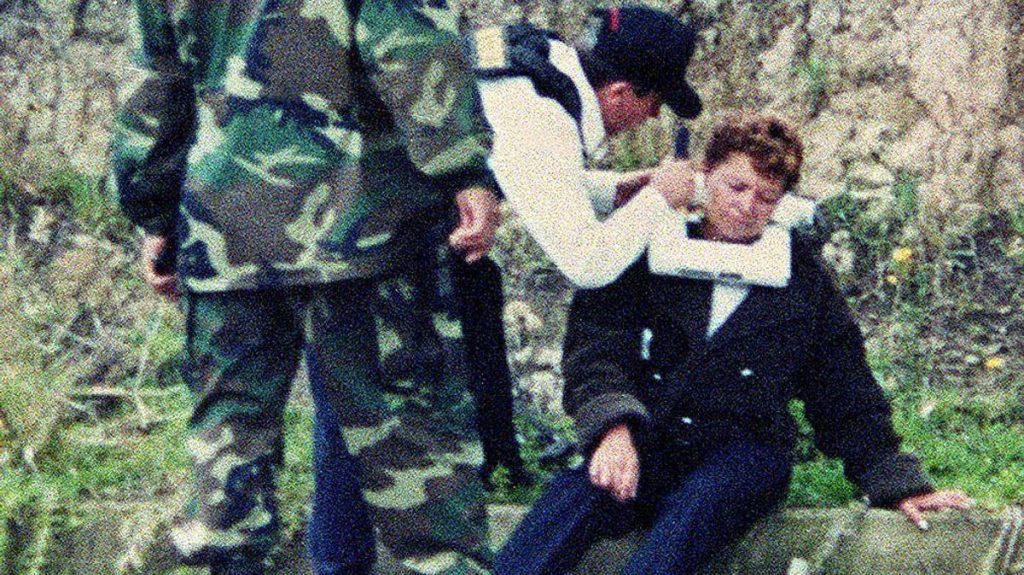
Four masked men fitted a dynamite-packed ‘necklace’ around the neck of a 53-year-old dairy farmer in an apparent extortion bid, and tragic final images have re-emerged of the incident

Elvia Cortes Gil de Pachon with a bomb collar around her neck(Image: Getty)
A chilling image shows the last moments of dairy farmer fitted with a sick ‘bomb collar’ and the bomb disposal expert who was fighting to save her life. The photo, which recently re-emerged on social media site Reddit, shows what experts described as “an extremely sophisticated device with three detonation mechanisms” locked around the 53-year-old Elvia Cortés Gil de Pachon’s neck.
Armed intruders burst into the victim’s home just outside Chiquinquira, Colombia, on May 15, 2000, and glued the bomb collar around her neck. Before leaving, they left a recorded message demanding a ransom of approximately $7,500 (around £5,600, equivalent of almost £11,000 today). The macabre message warned that the “almost impossible to deactivate” device would be detonated if the money was not paid.
Thousands of Colombians listened to live radio updates as the sickening incident unfolded. In reports, the intruders were identified as terrorist from the Revolutionary Armed Forces of Colombia (FARC) group, which had carried out out similar extortion attacks before.
After Elvia’s neighbours alerted the authorities, she was taken to an isolated stretch of road where for some six hours Colombian army bomb disposal experts attempted to defuse the device.
Sadly, the bid was unsuccessful and the device detonated at about 1pm. Army Lieutenant Colonel Fabio Roa told waiting reporters that Elvia had been “practically decapitated” by the blast. Police bomb disposal technician Jairo Lopez was also killed by the explosion, one soldier lost three fingers and part of his forearm, and another suffered severe lacerations from shrapnel.

Members of the Revolutionary Armed Forces of Colombia (FARC) group were blamed for the incident [file photo](Image: -, AFP via Getty Images)
Elvia’s family were present at the scene as the bomb detonated, and were seen immediately after the explosion tearfully trying to keep onlookers away from the scene.
In response to the tragedy, the country’s president, Andres Pastrana immediately cancelled planned peace talks with FARC representatives. “The men of violence have placed a necklace of dynamite … around the hope of all Colombians,” he said.
He added: “The FARC’s attitude must change, Forty million Colombians who want peace are demanding that change. I demand this (rebel group) demonstrate … its will for peace.”
Armed forces chief Gen. Fernando Tapias said that FARC rebels rigged the “necklace” of PVC pipe packed with dynamite around Elvia’s neck to force her husband to pay the ransom which the guerrillas described as a “war tax.”
An army spokesperson told reporters that Elvia had been singled out for the “atrocious experiment” because she had recently stopped paying extortion money. FARC had threatened to impose a “wealth tax” on any individuals or companies worth more than $1m (£625,000 at the time).

A bomb disposal expert spent six hours trying to defuse the device(Image: AP)
However, FARC denied responsibility for the incident. The group’s Ivan Rios insisted that no FARC fighters had been involved in the attack. “We had nothing to do with this condemnable act,” he told Radionet Radio. The group’s spokesman Raul Reyes added that there had been no reason to scrap the pace talks. “We’re asking the government to commit itself to . . . not make these unilateral decisions.”
Colombian newspaper columnist Abdon Espinosa wrote in the respected newspaper El Tiempo: “The idea of procuring peace in the midst of war has led us to tolerate and almost legitimise the worst abuses,” adding “Whether or not the FARC is responsible for the torture and death of Elvia Cortes, a re-framing of the peace process is called for.”
Over two decades later, the exact identities of those four masked men that fitted the bomb collar around Elvia’s neck remain unknown.