France wildfires ‘biggest threat since WW2’ as some compare to ‘last days of Pompeii’
French president Emmanuel Macron has visited the wildfire zone in south-west France, urging fire crews to ‘stay strong’ as he warned the battle against the Gironde blaze will take time

Flames have ripped through the countryside near Bordeaux(Image: AFP via Getty Images)
French President Emmanuel Macron has described the wildfires as the “biggest threat since World War II and warned that the battle will be a lengthy one. During a visit to a command centre for the extensive firefighting operation in south-west France, Mr Macron was briefed on the unpredictable nature of the blaze which has been raging since last week.
At times, it has morphed into a self-fuelling firestorm, consuming an area four times the size of Paris and forcing 220,000 residents to evacuate their homes. “We’re facing a completely unprecedented fire,” Mr Macron declared, labelling the situation as France’s most severe fire-related crisis since World War II.
He commended the firefighting teams who managed to halt the fire’s advance on Monday after consecutive days of spreading flames. However, with woodlands still smouldering, he warned that the fight is far from over.

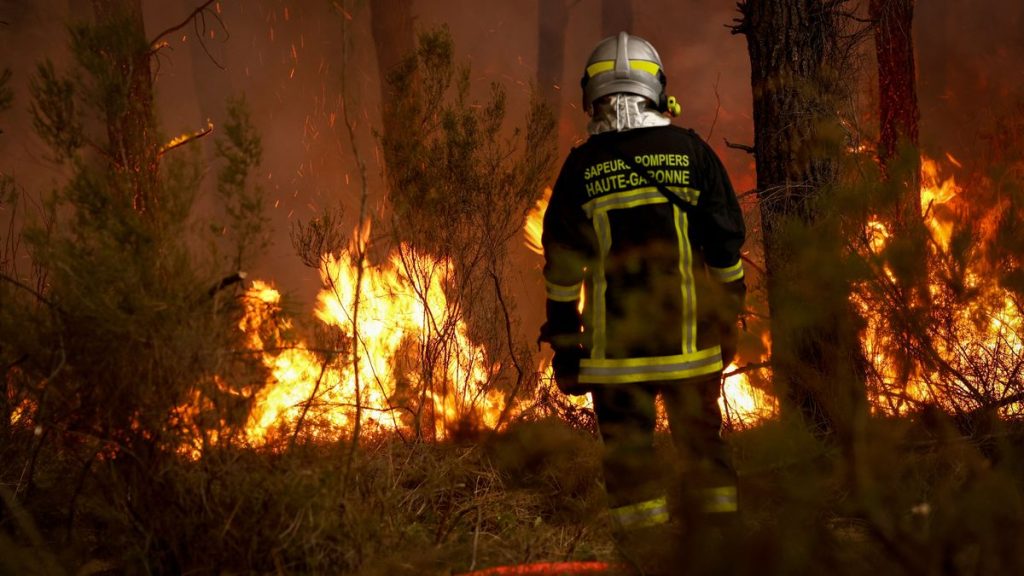
A firefighter stands before flames as a forest fire rages in Saint-Jean-d’Illac, some 30km from Bordeaux(Image: AFP via Getty Images)
“The weeks ahead will be hard,” he admitted.
With thousands of firefighters deployed and aircraft continuously dropping water and retardants, the effort has become a race against time ahead of an anticipated heatwave that could exacerbate the firefighting conditions.
Bordeaux resident Chris de Abrea told the BBC’s Today programme he is leaving the city for Paris today.
“[It] reminds me a little bit like Pompeii, especially over the weekend, the air was quite smokey, it was quite difficult to breathe. The smell of burning was pretty much all around the city,” he says.

France is dealing with multiple active wildfires(Image: incendieencours.fr)
The national weather service has predicted temperatures exceeding 35C in the south west on Tuesday, with even higher readings expected on Wednesday.
Regional authorities reported that the situation overnight into Monday had remained “globally stable” — a shift from previous days when officials warned that flames had edged to within 10 miles of Bordeaux’s outskirts, a historic city home to 268,000 people, and sparked self-feeding firestorms with lightning bolts that ignited further fires.
No additional evacuations were announced on Monday. However, as France prepares to enter its peak August tourist season, authorities in the Gironde region surrounding Bordeaux took measures to deter holidaymakers, imposing bans on holiday camps for children and individuals with disabilities.
Crews utilising earth movers have been tearing up strips of forest and scrubland to create barren areas, aimed at halting the spread of fires. Farmers have been supporting fire crews by supplying water, transporting it in tanks.

Firefighters tackle a blaze as wildfires rage near Le Las, outside Bordeaux(Image: AP Photo/Emma Da Silva)
Approximately a dozen countries have offered planes, helicopters, firefighters and other aid to both France and Spain, which is also grappling with unprecedented wildfires.
In total, fires in the two nations have compelled over 330,000 people to evacuate.
In Spain, wildfires have raged uncontrollably around Madrid and in the Valencia region. Authorities evacuated 79,000 people and ordered 30,000 others to remain in their homes.
In both Spain and France, the extraordinary scale of the fires — fuelled by heatwaves that struck particularly hard and early this year, rendering forests and scrubland bone-dry — are prompting calls for more robust action against climate change.

A plane flies over the flames in Cotignac(Image: AFP via Getty Images)
“What we are experiencing is not a series of isolated incidents. It is the consequence of a climate emergency that is making wildfires even more violent, heat waves more frequent,” stated Spanish Prime Minister Pedro Sanchez.
A blaze in the hilly, rural area of Avila, west of Madrid, has become Spain’s largest recorded fire, charring 193 square miles, according to the government. That’s five times the size of Barcelona.
“Look at how the valley is burned. Look at the houses, the people,” said David Gonzalez, a 48 year old gardener who used his van to deliver supplies to firefighters in Avila.
“We are feeling lot of anger and helplessness. It’s something inhuman,” he expressed.
Fires have consumed 590 square miles this year in Spain – six times the area ravaged by fires in the first half of 2025, revealed Sara Aagesen, the ecology minister.

Last week was the most destructive July week on record in Europe(Image: Anadolu via Getty Images)
The minister warned that another heat wave predicted from Tuesday – which would be Spain’s fourth this year – could escalate the fire risk. Spain’s weather agency anticipates temperatures exceeding 40C.
A wildfire fuelled by strong winds erupted on Sunday afternoon near Peschici, in Italy’s southern Puglia region, incinerating pine forest and scrubland and leading to the evacuation of about 300 tourists from beaches and campgrounds, authorities reported.
The Coast Guard evacuated holidaymakers by sea to nearby Vieste, where authorities set up temporary shelters.
Three Canadair water-bombing aircraft and firefighters on the ground carried on battling the inferno on Monday, which brought back memories of catastrophic wildfires that struck the same coastal region in 2007.