Ancient Greek goddess statue unearthed in Biblical city in ‘incredible’ discovery
The 2-metre-tall white marble statue of Athena was discovered lying face down in the rubble near the outer wall of the stage building in the ancient city of Laodicea, Turkey, in the area known as the postskene

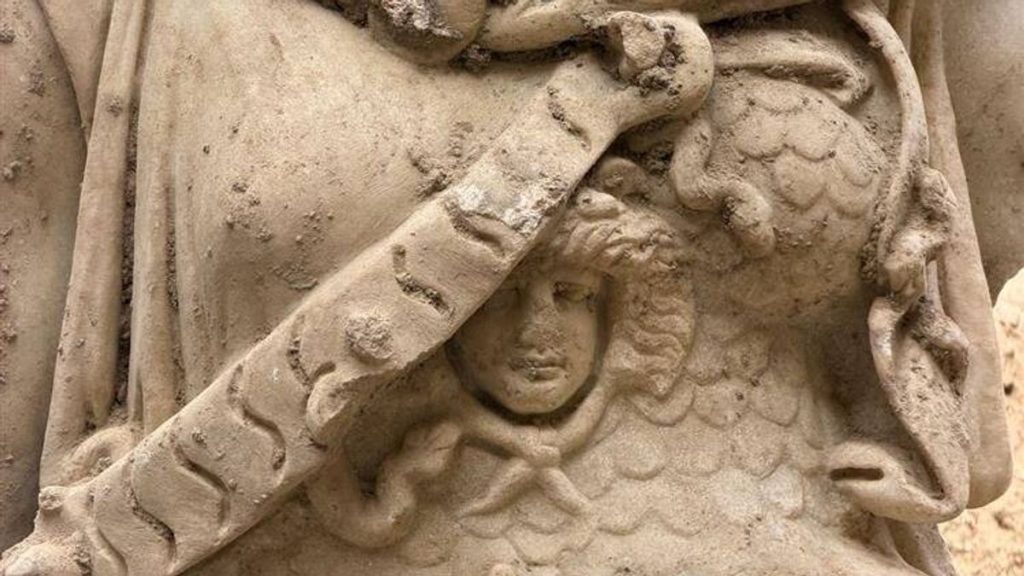
The aegis, as described in the Iliad, is an object carried by Athena and Zeus(Image: TÃ1⁄4rkiye Cumhuriyeti KÃ1⁄4ltÃ1⁄4r ve Turizm Bakanlığı/Cover Images)
A ground-breaking dig in an ancient Turkish city has revealed a colossal 2-metre-tall white marble statue of Athena in a location referenced in the Bible.
Archaeologists found the statue lying face down amongst debris near the outer wall of the stage building, in the region known as the postskene.
While the goddess’s head is still missing, the white marble body remains almost perfectly intact. The Laodicea site, in the West Theatre section of the excavation, dates back to the 2nd century B.C. and boasted a three-storey design, according to Turkiye Today.
This Athena statue is decorated with an aegis across her chest, displaying Medusa’s head and a series of intricate snakes.
The aegis, as outlined in the Iliad, is an item carried by Athena and Zeus, probably an animal hide or a shield, reports the Mirror US.
Since the sculptor designed the statue to be positioned between architectural columns, they left the rear of the piece in a crude, unfinished condition, meaning the front of the statue is elaborately detailed.
Each tier contained 16 columns, and the gaps between them functioned as a gallery for the gods. These statues frequently portrayed scenes from Homer, such as the Odysseus epic.
In the book of Revelation, the apostle John delivers a letter to the church at Laodicea, condemning them for being lukewarm. In 3:17, Jesus says to them, “You say, ‘I am rich; I have acquired wealth and do not need a thing.’ But you do not realize that you are wretched, pitiful, poor, blind and naked”.
The West Theatre site continues to supply the archaeology world with artefacts from the Roman era. Culture and Tourism Minister Mehmet Nuri Ersoy revealed the latest find as part of the “Heritage for the Future” project.
Ersoy stated: “In the stage building, we have brought to light the Athena statue, about 2 meters long, made of white marble.” Stylistic examination dates the statue to the reign of Emperor Augustus, which spanned from 27 B.C. to 14 A.D.
The realistic fabric draping and marble craftsmanship were characteristic of this period. The goddess stands upon a circular platform wearing a finely crafted, sleeveless peplos and a cloak, or hylamis, draped around her neck.
Earlier excavations in 2024 and 2025 uncovered figures depicting the sea creature Skylla and the cave of the giant Polyphemos.
In the city of Laodicea, Athena possessed importance beyond simply being the Goddess of war. Inscriptions discovered at the location reveal she was also the goddess of weaving, the primary industry of the ancient settlement.
The city’s inhabitants would hold festivals in her honour to celebrate her.