Ebola outbreak in DRC ‘spreading unchecked since January’ with 223 deaths reported
The deadly Bundibugyo ebolavirus may have been spreading unchecked in the DRC since January, with thousands potentially exposed as the third-largest Ebola outbreak ever recorded

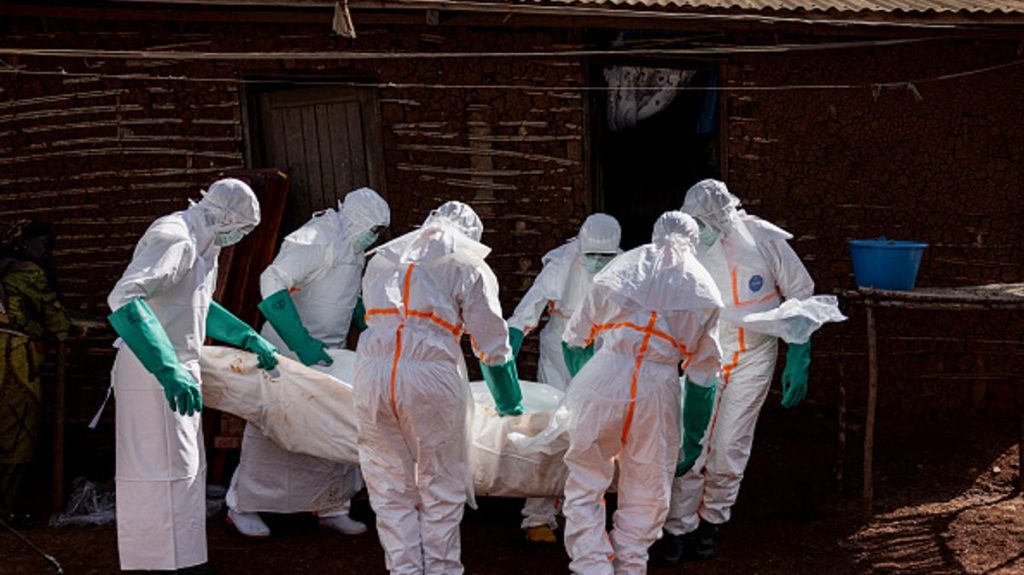
MONGBWALU, DEMOCRATIC REPUBLIC OF CONGO – MAY 24: Health workers wearing protective equipment carry the body of a suspected Ebola victim during safe burial procedures outside a family home in the community of Mongbwaluon on May 24
Ebola may have been spreading unchecked in the Democratic Republic of Congo (DRC) since January, with local authorities tracing the current outbreak of the deadly virus back to a patient zero at the beginning of the year.
However, for unknown reasons, this crucial information was kept from international NGOs by medical authorities until last week, with local doctors acknowledging they believe the 2026 outbreak originated with a patient treated at a hospital in the eastern DRC village of Rwampara.
Local doctors say patient zero arrived at hospital in late January and passed away in February. The Telegraph reports the patient subsequently infected eight healthcare workers before dying.
In the months since, there have been at least 1,077 suspected cases and 223 deaths linked to the rare Bundibugyo strain that has emerged from the DRC in recent months, reports the Mirror.
There have also been nine cases in neighbouring Uganda.
Should information from local healthcare workers be verified, the details that have recently emerged suggest the terrifying virus has been circulating without restraint for months.
The 2026 outbreak represents the third-largest Ebola outbreak ever documented and was only formally confirmed by the Congolese Ministry of Health on May 15.
This would indicate the virus has had months to spread wildly through communities without intervention. The World Health Organisation (WHO) initially thought the index case was a healthcare worker in Bunia in the DRC, who exhibited symptoms of Ebola on 25 April and later passed away.
Along with numerous international NGOs, the revised health data was also disseminated to the International Rescue Committee (IRC), Action Aid, and Médecins Sans Frontières (MSF).
Rachel Howard, IRC Senior Technical Emergency Health Advisor, stated: “The true scale of this Ebola outbreak is likely far worse than official figures suggest”.
“When four out of five contacts are not being traced, it becomes incredibly difficult to contain the outbreak or even understand its true scale. We’re especially concerned about the virus spreading to other countries like Burundi or South Sudan,” Ms Howard further commented.
If the outbreak did indeed commence as early as January, many thousands more individuals may have been exposed to the Bundibugyo ebolavirus, which is notoriously challenging to manage and has no known licensed vaccines or treatments.
Just 20 per cent of individuals known to have had close contact with Ebola patients in the DRC since the official outbreak date in April have subsequently been contact traced.
Thousands remain unaccounted for – and there’s no telling what that figure would be if the Bundibugyo ebolavirus has been spreading unchecked since January.
Containment efforts have been further hindered across Africa due to unstable security situations, alongside community mistrust and conspiracy theories, made worse by relatives who have been prevented from burying their family members who have perished from the horrific disease.
Last week, a treatment centre in Rwampara operated by MSF was attacked by a group of people attempting to recover the bodies of their relatives who had died of Ebola – bodies that would still be infected with the lethal disease.
And, to compound matters further, nearly one million people have been displaced by conflict in the DRC’s Ituri province, the epicentre of the outbreak and one of the most troubled regions of the DRC, where armed groups, rebels linked to the Islamic State, and community militias regularly conduct massacres.
WHO Director-General Tedros Adhanom Ghebreyesus visited Ituri in the DRC last week amid the outbreak and said more international support was needed to curb the virus’s spread. Healthcare workers on the ground are in dire need of basic supplies such as face masks, but the international health agency is struggling, having received only a fraction of the financial support required to assist on the ground.
Additional funding is necessary for distributing testing kits, establishing treatment tents, and conducting contact tracing.
The British government did pledge £21 million to the DRC just last week to aid containment efforts.
However, critics have been swift to highlight that these millions of pounds represent merely five per cent of the aid dispatched by the UK to combat the 2014 outbreak in West Africa.
The UK and other western nations have drastically reduced their aid budgets to divert those funds towards defence.
For instance, the US experienced widespread aid cuts when the Trump administration took office.
The US withdrew funding from WHO, disbanded the US Agency for International Development (USAID), implemented cutbacks at the US Centres for Disease Control and Prevention, and is currently decreasing the total health aid it provides to DRC and Uganda, the countries at the heart of the latest Ebola outbreak.
All these measures have undermined global health systems that are crucial in responding to outbreaks like the one we are currently witnessing in the DRC.