Pope Leo says he has returned to his “homeland” Peru in final leg of South America trip
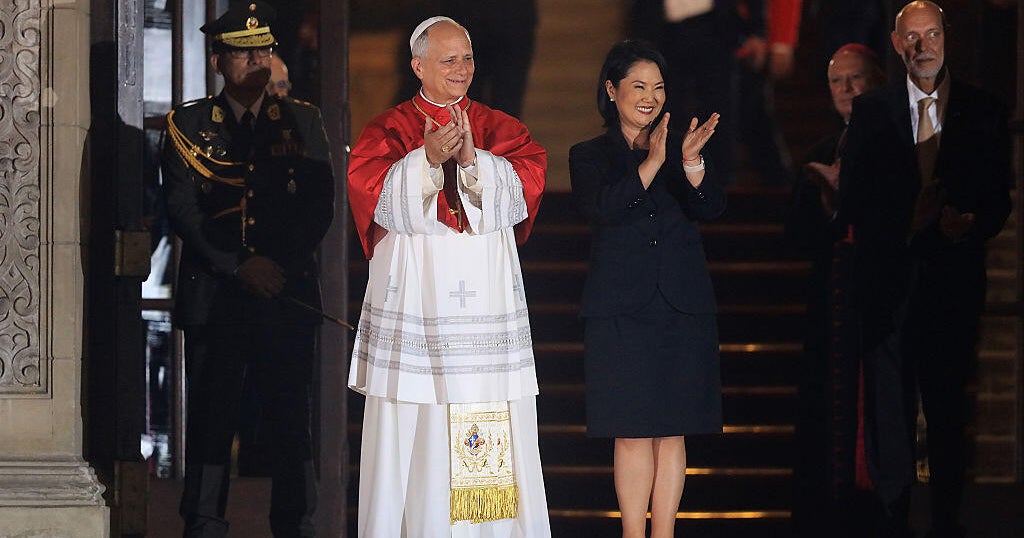
Pope Leo XIV declared Peru his “homeland” on Wednesday as he arrived in Lima at the start of his historic visit, returning to the place that taught him how to be a pastor and where a nationwide party erupted to welcome the beloved “Padre Robert” home.
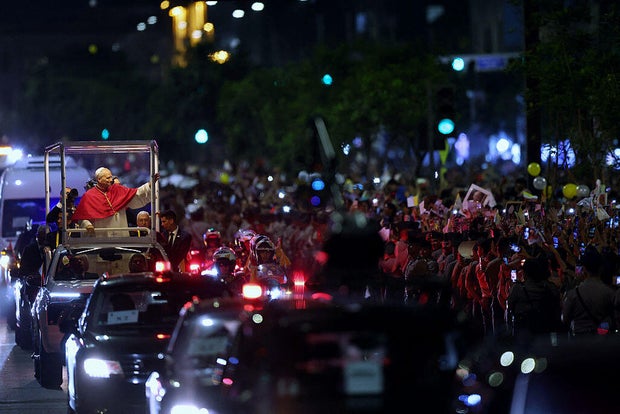
Leo seemed genuinely moved as he emerged from his charter plane, smiling broadly at nearly every turn of his first moments on Peruvian soil. The Vatican estimated that some 3 million people lined Leo’s miles-long motorcade route into town, waving Peruvian and Holy See flags.
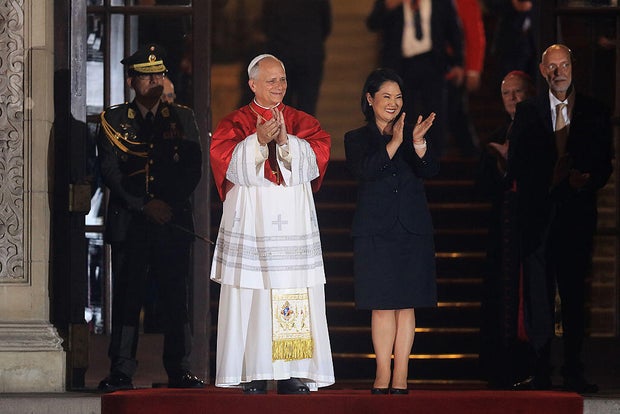
Some in the roaring crowds broke through the tight security to chase behind the car that transported him to the presidential palace, where Leo met privately with Peruvian President Keiko Fujimori. During the formal welcome ceremony in the palace courtyard, he sang the Peruvian national anthem alongside Fujimori and a children’s choir.
Miguel Marruffo /AFP via Getty Images
In his first remarks to Fujimori and government officials, the Chicago-born Leo said the Peruvian citizenship he acquired in 2015 cemented a bond that began long before, crediting Peruvians with having formed him as a pastor by sharing their lives, joys and struggles with him.
“Today I understand how much of this land remains with me and how much of my own story also belongs to you,” he said.
“That is why I can tell you, with deep gratitude, that I am also returning to my homeland,” he said to applause.
Popemania descends on Peru, where Leo lived and served for decades
The visit to Peru marked the final leg of Leo’s three-nation South America tour and its emotional highlight, given the more than two decades that Leo, formerly Cardinal Robert Prevost, spent in Peru as a missionary priest and later bishop. He has said it was here that he learned “what it means to be a shepherd.” As a dual citizen of the U.S. and Peru, he’s the first pope from each country.
“We love him so much because he’s worked here, he knows our sufferings, he knows it all,” said 85-year-old Evelina Cruz, who held a pope plush doll made by her niece as she waited for Leo to arrive.
Mariana Bazo / Getty Images
In preparation for the pope’s visit, a huge 46-foot statue of the pontiff was unveiled in the port of El Callao. Baristas in Lima, the capital, were offering cappuccinos decorated with the image of the pope.
“My heart is so excited that it makes me want to cry with joy,” said Zuly Castillo, who served as Leo’s
secretary when he was bishop of the northern city of Chiclayo near the Pacific Coast.
Gustavo Morello, an associate professor of sociology at Boston College and the author of “Lived Religion in Latin America,” said the trip was a “return to his origins, without any doubt.”
“Peru is the crown of the trip, the homecoming of the first Peruvian pope, no matter where he was born,” he said.
With hands raised and voices lifted in song, hundreds awaited the pope’s arrival in Lima in front of the presidential palace. “Long live Christ!” the crowd sang, following a Catholic choir on the stage.
Popemania also hit Chiclayo, where Leo arrives on Friday. Leo is painted in colorful murals, emblazoned on T-shirts, baseball hats and even bobblehead dolls.
Over the coming days, Leo will celebrate Mass in all his old stomping grounds including at the nearby sanctuary of St. Turibius of Mogrovejo in Zaña, a city that is a hub of Afro-Peruvian culture, and where the pope often visited to pray to the saint of his devotion.
Since Leo knows his adopted country so well, his speeches will be closely watched, especially one he’ll deliver from the square in front of Lima’s cathedral Thursday “on the challenges and hopes for the future of the Peruvian people.”
Pope to honor Peru’s Indigenous peoples in the Amazon
The pope will honor Peru’s Indigenous peoples by traveling to Pucallpa, in Peru’s Amazon, to celebrate Mass. Illegal gold mining and the cultivation of coca leaves, the raw material used to produce cocaine, are affecting Peru’s Indigenous peoples.
“The Amazon is a place where critical issues affecting development — such as the environmental crisis, the exclusion of Indigenous peoples, various forms of violence, and extreme poverty — all intersect,” said Pérez.
Leo will also meet with popular groups of faithful and representatives of local traditions in Cusco — the capital of the Inca Empire, an important city of Spanish colonial rule and an important cultural
destination, including the nearby ruins at Machu Picchu.
The pope will celebrate Mass in Cusco’s main square, where in 1781 the Indigenous hero Túpac Amaru II was killed following the most significant rebellion against the Spanish during the colonial era.
Pope arrives in Peru about one month after undergoing lung cancer surgery
The pope’s arrival in Peru comes about one month after he underwent surgery in Italy to remove a nodular lesion from his right lung, during which surgeons confirmed he had lung cancer. The Vatican announced at the time that the 71-year-old had been diagnosed with adenocarcinoma, and that the surgery had been successful.
Just two weeks after he underwent the surgery, doctors cleared him to make the South American trip, which started in Uruguay and took him to Argentina.
During an address in Uruguay last weekend, the pope used his own experience with cancer to push for access to universal healthcare.
“Recently I experienced firsthand the limitations imposed by illness, and I received care for which I am grateful,” the pope said. ” … Ensuring that healthcare is accessible to everyone, regardless of their resources, is a duty that confronts every society.”
At the start of his trip, the pope also confirmed that he voted by mail in the U.S. midterm elections in Chicago, the first sitting pontiff to vote in a U.S. election.
Pope Leo says he has returned to his “homeland” Peru in final leg of South America trip
#Pope #Leo #returned #homeland #Peru #final #leg #South #America #trip