Supersonic jets set for comeback as US moves to lift 50-year ban
Supersonic passenger jets could soon streak across American skies after the FAA announced plans to replace its 50-year ban on overland supersonic flight with a noise threshold — meaning aircraft can break the sound barrier without the infamous sonic boom rattling homes below.

(Image: Getty)
Supersonic aircraft are set to return after the US made a major move towards scrapping a 50-year prohibition.
The Trump administration argues that technological advances now allow planes to break the sound barrier without creating the thunderous sonic boom.
Since 1973, the Federal Aviation Administration has prohibited civilian aircraft from exceeding Mach 1 over US territory to prevent disruptive sonic booms.
The Department of Transportation plans to replace the ban on overland supersonic flight with a noise limit.
This would allow an aircraft to fly faster than Mach 1 over land as long as the sound produced stays below a designated level, a notice issued by the FAA on Tuesday, June 30, revealed.
The announcement follows an executive order by US President Donald Trump issued in June 2025 directing the FAA to scrap its “prohibition on overland supersonic flight … establish an interim noise-based-certification standard … and remove additional regulatory barriers that hinder the advancement of supersonic aviation technology in the United States.”
Mach 1 represents the speed of sound, which is approximately 1,235 km/h (767 mph or 343 m/s) in dry air at sea level at 20 °C.
The FAA plans to finalise both regulations by mid-2027, the notice stated. FAA Administrator Bryan Bedford declared that technological advances will eliminate the traditional sonic boom.
“This means we can ultimately repeal the ban from the 1970s on supersonic flight over US territory while minimising noise impacts to residents in communities along the route and near airports,” he continued.
Throughout the 1960s, aircraft flying faster than the speed of sound – approximately 660 mph at high altitudes – produced shock waves that hit the ground and struck human ears as a thunderous crack similar to a gunshot, according to Forbes.
Trials during that era showed that repeated sonic booms smashed windows, caused property damage and triggered thousands of complaints from the public.
In its 1973 decision, the FAA announced that given the technological constraints of the time, “a prohibition was needed to protect the public from sonic boom”.
Several years later, Air France and British Airways introduced Concorde.
Both airlines were allowed to run services into New York’s John F. Kennedy International Airport, although flights had to stay subsonic while over US territory.
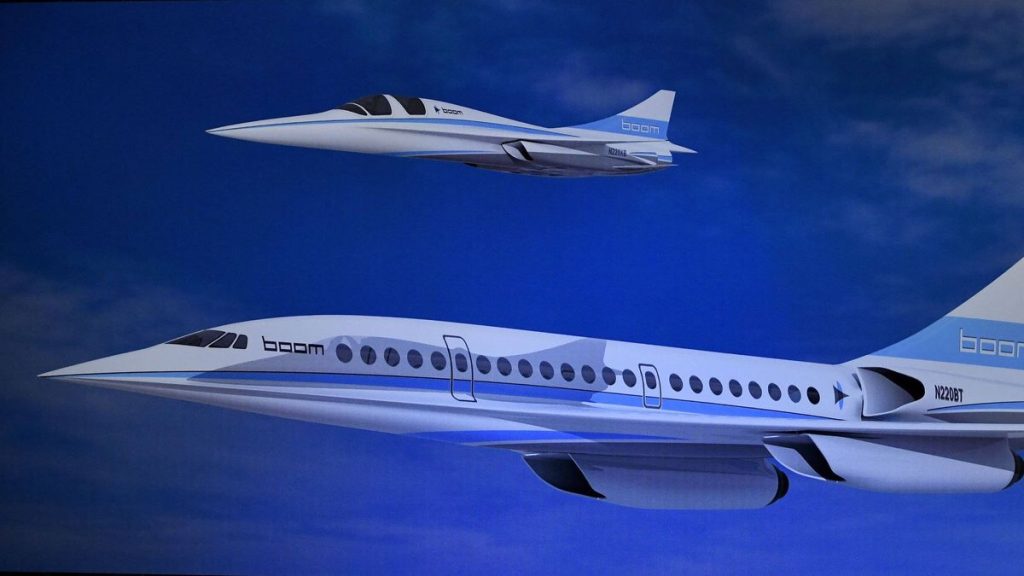
A host of American companies are presently creating a fresh generation of luxury supersonic passenger aircraft featuring significantly quieter sonic booms and improved fuel efficiency.
Colorado-based Boom Supersonic says it has obtained pre-orders from United Airlines, American Airlines and Japan Airlines for its Overture aircraft, which will seat 60-80 passengers. Atlanta-based Spike Aerospace is developing its smaller Diplomat jets, intended to accommodate up to 18 passengers.
Both companies’ websites advertise future transatlantic trips that can be completed in less than four hours.