What next as Netanyahu’s party claims Israel’s election was stolen?

Tel Aviv — Prime Minister Benjamin Netanyahu and his Likud party alleged Thursday that Israel’s election earlier in the week was stolen by Arab-majority parties, helped by foreign funding that amounted to vote-buying, as final results showed Netanyahu’s bloc has lost its majority in Israel’s parliament, the Knesset.
Israel’s Arab-majority parties had their highest turnout ever in Tuesday’s election, winning an unprecedented 19 of the Knesset’s 120 seats. Their success is one of the main reasons Netanyahu’s bloc lost its majority and can’t now form a new government.
The final election results show the far-right wing bloc’s share of Knesset seats fell from 68 to 53.
Israel’s Arab minority, also called Palestinian citizens of Israel, makes up about 20% of the country’s population.
“Israel’s elections have been stolen,” Netanyahu’s Likud party declared in a statement Thursday, claiming “an attack on democracy aimed at leading to a foreign takeover of the Knesset, the Islamization of Israel, and the overthrow of the right-wing government to cause a withdrawal and defeat of the IDF (Israeli military) on all fronts — first and foremost, Iran.”
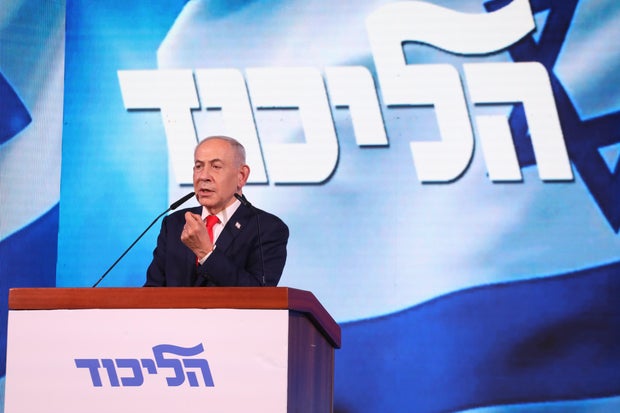
Amnon Gutman/Bloomberg/Getty
The four parties that make up the main bloc opposing Netanyahu won 48 seats, so they would need some support from the Arab parties to try to form a coalition government, assuming none of the lawmakers currently aligned with Netanyahu’s bloc defect.
The heads of Israel’s two biggest Arab parties, which collectively won 19 seats, have said they would be willing to help the main opposition bloc oust Netanyahu from power.
Most of the Jewish-led parties that oppose Netanyahu vowed before the election not to rely on support from Arab parties to form a government, however, leaving a question mark over whether they might now be willing to cooperate to build a coalition to unseat the incumbent prime minister.
“No basis to the claims regarding a systematic compromise”
The Shin Bet, Israel’s internal security agency, said it had opened an investigation into possible foreign influence in the election, but the scope of that investigation has not been made clear.
“An investigation of this type is also focused and bounded, and does not cast aspersions or place blame on an entire sector that went out to vote democratically and legally,” the agency said in a Thursday statement.
The Acting Director-General of the Central Elections Committee, Din Livne, said in a letter to a committee member on Thursday that “there is no basis to the claims regarding a systematic compromise of the integrity of the elections.”
Israel media reports said one of the allegations the Shin Bet investigation would consider was whether Qatar had sent money to Arab parties in order to increase turnout among Arab Israeli voters.
Qatar’s foreign ministry has denied the accusation.
“We categorically deny allegations that Qatar has interfered in Israeli elections or funded any activities intended to influence their outcome,” ministry spokesperson Majid Al-Ansari said. “Qatar should not be used as a scapegoat for the political failures of certain Israeli politicians.”
“An improper influence operation?”
While vote counting is now officially complete, the election results must still be certified and sent to President Issac Herzog before a new parliament can be sworn in and the process of forming a new government begins.
Gadi Eisenkot, head of the centrist Yashar party and the top candidate to replace Netanyahu as prime minister, said he was worried that Netanyahu could be using the allegation of a stolen election to justify delaying or disqualifying the results.
“Netanyahu, who has accustomed himself to dealing with reality through lies, consciousness engineering, and the spreading of chaos, is leading alongside his partners an improper influence operation on the Israeli public aimed at delaying the publication of the election results on time and creating fictitious delegitimization of the activity of the 26th Knesset,” Eisenkot said Thursday in a social media post.
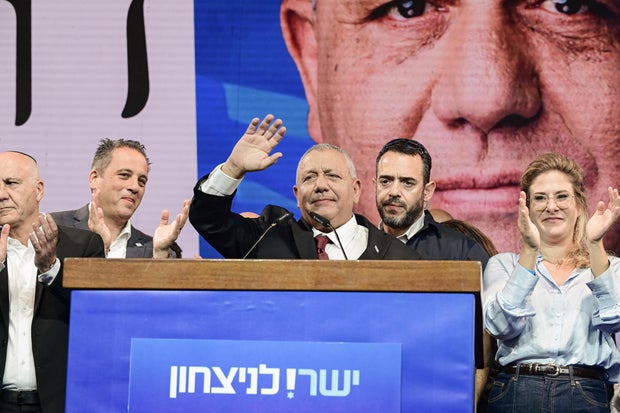
Tomer Neuberg/Middle East Images/AFP/Getty
Once the new Knesset is sworn in — even without a new government decided on — Eisenkot’s bloc, along with the Arab parties, could begin passing laws given that they will control a majority in the parliament.
Netanyahu, who President Trump endorsed enthusiastically, will remain in his post as a caretaker prime minister until a new government is formed. If the parties cannot negotiate to form a new coalition government, then the country would have to hold the election all over again, and Netanyahu would remain the prime minister in the interim.
What next as Netanyahu’s party claims Israel’s election was stolen?
#Netanyahus #party #claims #Israels #election #stolen