Loners who decided to escape the modern world and live fully ‘off grid’
With AI robots on the rise, Donald Trump in the White House and zany tech bros like Elon Musk ruling social media − it’s enough to give anyone the blues. In fact, you’d be forgiven for wanting to stop doomscrolling on your phone and just run away and properly escape it all.
More and more people are becoming gradually disillusioned with what is going on in the world. Because of that, many are wondering if it would be better to go “off-grid” and live out the rest of their lives in peace, away from the rest of civilisation.
But could you take the ultimate step and live your life off-grid? Here we reveal the tales of six brave souls who decided to shun the modern world − but ended up with mixed results.
Rock star
Georgian monk Maxime Qavtaradze lived at the top of a narrow, natural 130ft pillar of rock in Georgia for more than 20 years. Katskhi was the site of an ancient hermitage.
Before the small hut he inhabited was built, Maxime slept in an old fridge. Later, with little more than a bed for comfort, he had supplies winched up on a rope from locals and spent his time praying and reading, saying: “I need the silence.”
But old age and too many tourists led him to return to the local monastery in 2015.
Mud for it
Oxford University graduate Emma Orbach, who grew up in a castle, seemed an unlikely person to quit the rat race for a Hobbit-like existence in the wilds of Pembrokeshire, Wales.
But since 1999, the 69-year-old mum-of-three has been living in a round hut she constructed herself out of mud, straw and manure. She says: “I never found a way to feel happy in the modern world.”
Emma lives without electricity or running water, instead taking it from a local stream. She grows her own food and keeps goats and chickens, adding: “This lifestyle makes me feel really happy.”
Tattoo and ta-ta
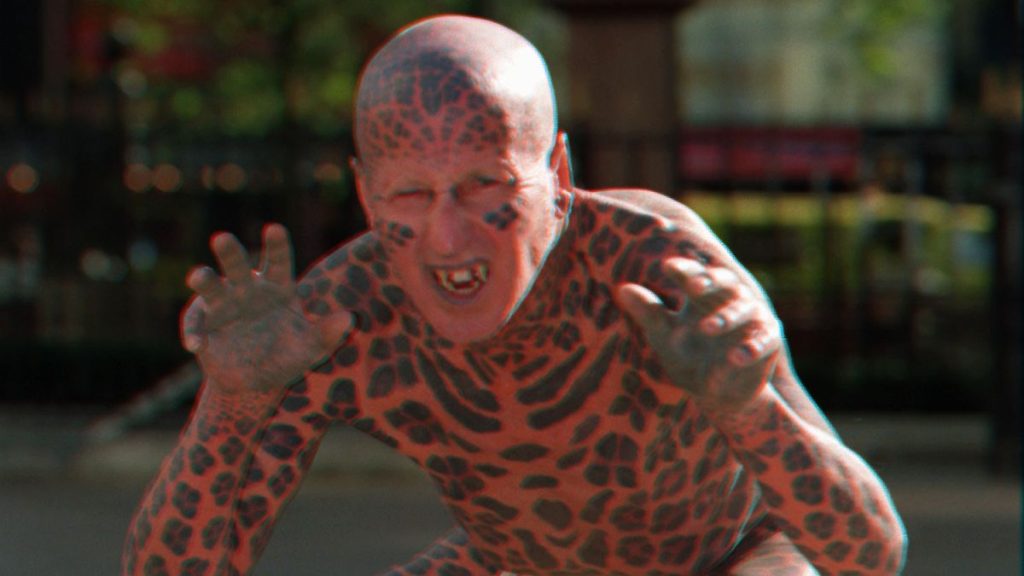
Eccentric ex-soldier Tom Leppard, born Tom Wooldridge, covered himself in body art that made him look like a human leopard and went to live in isolation on the isle of Skye, off Scotland. He would spend the next 20 years living in a self-built hut there, with a makeshift roof of plastic sheeting and no electricity or furniture.
Tom – who once held the title of the most tattooed man in the world – canoed three miles to the mainland, to pick up groceries and his pension every week. He said he wanted to “escape the city” but was “never lonely”.
in 2008, age forced him to move into a one-bedroom home in a local village. He died, at 80, in 2016.
Out there
American university graduate and adventurer Chris McCandless headed off into the Alaskan wilderness in April 1992 alone, determined to live off the land. Equipped with little more than a large bag of rice, a rifle and some wellies, he made his home in an abandoned bus and kept a journal.
For a few months he lived off edible plants, squirrels and even managed to kill a moose, but the meat soon spoiled. Deciding to return to civilisation, the 24-yearold found that a flooded river had cut him off.
Tragically, he would die of starvation. His story was adapted into the 2007 movie into The Wild.
Siberian survivor
Dubbed the “world’s loneliest woman”, Agafia Lykova, now 80, has been living on her tod in a wooden hut in the remote Western Sayan mountains of Siberia since the 1980s. She is the last member of her family, who fled there from religious persecution under Stalin’s Soviet Union.
They managed to become self-sufficient, settling 150 miles from the nearest village. Agafia, who grows crops and keeps livestock, only leaves for medical treatment and says she prefers keeping away from the hurly-burly.
Real Robinson Crusoe
In 1989 Italian PE teacher Mauro Morandi, from Dodena, headed off in a yacht for a new life in the Pacific. He said: “I wanted to escape from this society, which I don’t like.”
But when he was shipwrecked off the island of Budelli, near Sardinia, famous for its pink beaches, he decided to stay, becoming a caretaker for its owner. He lived solo on the mile square island in an old World War Two shelter without TV or radio.
But Mauro did eventually cobble together a solar power system for his fridge and got food delivered from the mainland. He stayed for 32 years until being forced to leave when the island became part of a national park. He died last year aged 85.
Ensure our latest headlines always appear at the top of your Google Search by making us a Preferred Source. Click here to activate or add us as a Preferred Source in your Google search settings.